
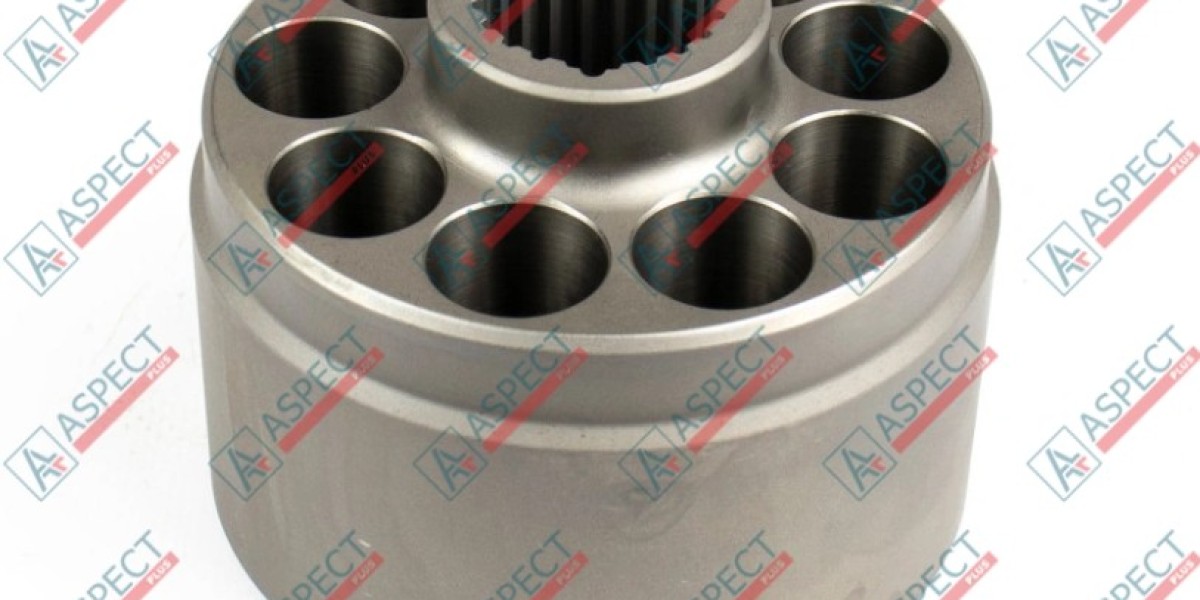
Sauer-Danfoss H1P series axial piston pumps (H1P045, H1P053, H1P078, H1P089, H1P100, H1P115, etc.) represent the pinnacle of hydrostatic evolution. They replaced the legendary Series 90 on modern combines, sprayers, and road machinery. The H1P is a "smart" pump with compact servo control.
However, this entire complex system depends entirely on one simple parameter - Charge Pressure. If it disappears, the pump instantly turns into an immobile brick. The main culprit for this is often a small but critical assembly - the Charge Pressure Relief Valve (CPRV).
Why is This Valve Needed?
The H1P pump has a built-in gerotor pump that draws oil from the tank. It creates flow, but not pressure. Pressure is created by resistance. The CPRV is a spring-loaded valve that stands in the path of this flow and creates artificial resistance, maintaining system pressure at 20-28 bar (depending on model and RPM).
This pressurized oil (25 bar) performs three functions:
- Servo System Power: Without this pressure, the servo pistons cannot tilt the swashplate.
- Cavitation Protection: It pressurizes the main circuit pistons, preventing vacuum formation.
- Brake Release: Often this pressure is used to release the parking brake.
Symptoms of CPRV Failure
- Monitor Error: Modern equipment immediately displays a "Low Charge Pressure" error code.
- Machine Won't Move: The engine runs, the joystick is pushed, but the pump stays at zero. The servo piston simply has nothing to push the plate with.
- "Spongy" Hydraulics: The machine responds slowly because the charge pressure is too low (e.g., 10-12 bar instead of 25).
- Cavitation Noise: Crackling is heard in the pump because the pistons are running "dry."
Anatomy of the Failure: What Happens to the Valve?
The CPRV in the H1P series is usually located in the charge pump housing or the end cap (check the hydraulic schematic for the specific model).
1. Debris Stuck in Poppet
This is cause #1. A single small shaving or a piece of rubber from a hose is enough to jam the valve in the open position.
- Consequence: Oil drains freely into the pump case without creating pressure. The gauge will show 0-5 bar.
2. Spring Sag or Breakage
The valve spring constantly compresses and decompresses. Over time, it loses stiffness.
- Consequence: Pressure drops smoothly. Instead of 25 bar, you see 18, then 15. When the oil heats up (viscosity drops), the machine stops.
3. Poppet Cone Wear
If there is abrasive in the oil, the locking cone of the valve (poppet) and the seat wear out, losing their seal.
Diagnostics and Solutions
Step 1: Pressure Measurement
Locate port M3 (Charge Pressure) on the pump housing.
- Connect a 0-60 bar pressure gauge.
- Start the engine. At idle, pressure should be at least 18-20 bar. At full RPM - 24-28 bar.
- If pressure is low or fluctuating - the problem is in the charge circuit.
Step 2: Valve Inspection
- Unscrew the CPRV plug (careful, there is a spring under tension!).
- Remove the spring and the poppet.
- Inspection: Look for scratches on the valve cone or foreign objects. If you see a shiny band on the cone, but it is intermittent - the valve is not sealing.
Step 3: Adjustment (Shimming)
In many H1P models, pressure is adjusted by placing shims under the spring.
- Rule: Adding a 1 mm shim raises pressure by approximately 3-5 bar (check manual for exact data).
- Warning: Do not exceed the allowable pressure! If you raise pressure above 35 bar, you will blow out the Shaft Seal, and oil will pour out.
If cleaning and adjustment do not help, this may indicate wear on the gerotor charge pump itself, which simply cannot pump the required volume.
Aspect Plus offers spare parts for Sauer-Danfoss H1P pumps: CPRV valves, calibrated springs, seal repair kits, and gerotor pump sets.